
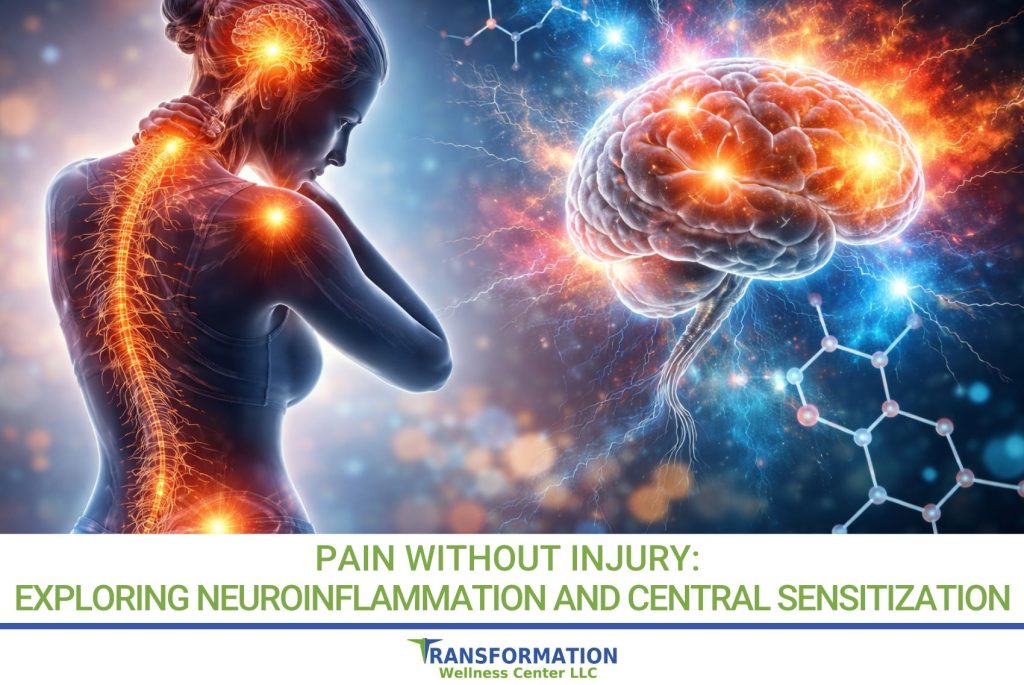
Have you ever experienced ongoing pain even though imaging, lab work, or exams show “nothing wrong”? You’re not alone—and more importantly, you’re not imagining it. Pain without an obvious injury is very real, and modern neuroscience is giving us better answers as to why it happens.
At Transformation Wellness Center, we specialize in helping patients understand and address chronic pain conditions that don’t fit the traditional injury-based model. Two key concepts often involved are neuroinflammation and central sensitization.
Understanding these processes can be a powerful first step toward real, lasting relief.
When Pain Isn’t Caused by Tissue Damage
For years, pain was viewed primarily as a sign of injury—something damaged, inflamed, or structurally wrong. While that’s true in many cases, it doesn’t explain why some people experience:
- Widespread body pain
- Pain that shifts locations
- Sensitivity to touch, pressure, light, or sound
- Fatigue alongside pain
- Symptoms that worsen with stress or poor sleep
This is where the nervous system itself becomes the primary driver of pain.
What Is Neuroinflammation?
Neuroinflammation refers to inflammation within the brain and spinal cord, not just in muscles or joints. Unlike classic inflammation (swelling, redness, heat), neuroinflammation is more subtle—but highly impactful.
Common triggers of neuroinflammation include:
- Chronic stress
- Past injuries or surgeries
- Repeated pain signals over time
- Autoimmune or metabolic dysfunction
- Poor sleep and hormonal imbalance
When the nervous system stays inflamed, it becomes more reactive. Signals that shouldn’t be painful may begin to hurt, and existing pain signals can become amplified.
Understanding Central Sensitization
Central sensitization occurs when the brain and spinal cord become overly sensitive to sensory input. Essentially, the volume knob on pain is turned up—even when there’s no ongoing tissue damage.
Key characteristics of central sensitization:
- Pain that persists after healing should have occurred
- Pain disproportionate to physical findings
- Increased sensitivity to normally non-painful stimuli
- Pain that flares during emotional stress or fatigue
Conditions commonly associated with central sensitization include:
- Fibromyalgia-type symptoms
- Chronic unexplained pain
- Migraines
- TMJ disorders
- Chronic pelvic pain
- Post-concussion symptoms
Why Traditional Treatments Often Fall Short
Many patients with neuroinflammation or central sensitization are told:
- “Your tests are normal.”
- “You just have to live with it.”
- “It’s all stress.”
While stress can contribute, these conditions are neurological and physiological, not imagined. Treatments that focus only on pain medications or isolated body parts often miss the bigger picture—the brain-body connection.
A Different Approach at Transformation Wellness Center
At Transformation Wellness Center, we take a whole-person, neurologically informed approach to chronic pain.
Rather than asking “Where does it hurt?” we ask:
- How is your nervous system functioning?
- How does your brain process pain signals?
- What is driving inflammation at a neurological level?
Our goal is to calm the nervous system, reduce neuroinflammation, and retrain pain pathways—helping the body regain balance and resilience.
Comprehensive Q&A: Pain Without Injury
Q: Is pain without injury real?
Yes. Pain is produced by the nervous system. Even without tissue damage, altered nerve signaling can create very real pain.
Q: Why does my pain move around my body?
This is common in central sensitization. The brain may amplify pain signals across multiple regions rather than one specific injury site.
Q: Can stress really make pain worse?
Absolutely. Chronic stress keeps the nervous system in a heightened state, increasing inflammation and pain sensitivity.
Q: Why do my symptoms flare when I’m tired or not sleeping well?
Sleep is critical for nervous system repair. Poor sleep increases neuroinflammation and lowers pain tolerance.
Q: Are fibromyalgia and chronic pain “all in my head”?
No. While the brain is involved, these conditions are based on measurable changes in nervous system processing—not imagination.
Q: Can the nervous system calm down once it’s sensitized?
Yes. With the right care, the nervous system is adaptable and capable of healing.
Q: Why do medications help only temporarily—or not at all?
Medications may dull symptoms but often don’t address the underlying neurological drivers of pain.
Q: How long does it take to see improvement?
Each person is different. Many patients notice gradual improvements in pain intensity, frequency, and overall function as the nervous system stabilizes.
Q: What if I’ve tried everything already?
Many of our patients come to us after years of unanswered questions. A neurological approach often reveals missing pieces others have overlooked.
You Deserve Answers—and Relief
Chronic pain without injury can feel isolating and frustrating. Understanding neuroinflammation and central sensitization helps replace confusion with clarity—and opens the door to meaningful change.
At Transformation Wellness Center, we believe your pain has a reason—and that your body has the capacity to heal when supported properly.
Contact Information
Transformation Wellness Center
2501 Blichmann Avenue, Suite 110
Grand Junction, CO 81505
📞 Phone: (970) 812-5559
🌐 Website: mytransformationwellness.com
📅 Request an Appointment:
https://mytransformationwellness.com/contact/
Disclaimer: The information in this post is for educational purposes only and does not constitute chiropractic advice, medical advice, or a provider-patient relationship from Dr. Andrea Jordheim, DC, CFMP. It aims to inform, not diagnose or treat conditions. Always consult your licensed healthcare provider before health changes.